Ceremonies & Rituals
What Almost Every Wedding Ceremony Is Doing, Whatever Tradition It Belongs To
The forms differ enormously. Underneath them, most ceremonies are performing a small number of the same functions, and recognising them makes any ceremony easier to read.
This looks at the shared structure of wedding ceremonies from the practical end — what holds up once conditions stop being ideal.
What holds up in practice
- Consent, witness and public declaration recur across traditions.
- A physical act usually marks the moment of change.
- Who performs the ceremony varies from priest to state official to the couple themselves.
Consent, freely given
Nearly every tradition requires the two people to agree, in some form of words or gesture, and to do so without compulsion. In Islamic practice this takes the form of an explicit offer and acceptance; in Catholic practice the exchange of consent is the essential element of the sacrament. Civil ceremonies almost always contain prescribed words in which each party states that they know of no impediment and take the other as their spouse.
Some traditions express consent through the families as well as the couple, which does not remove the individual requirement in most cases. Where a ceremony has a single indispensable moment, it is usually this one.
Witness, formal and communal
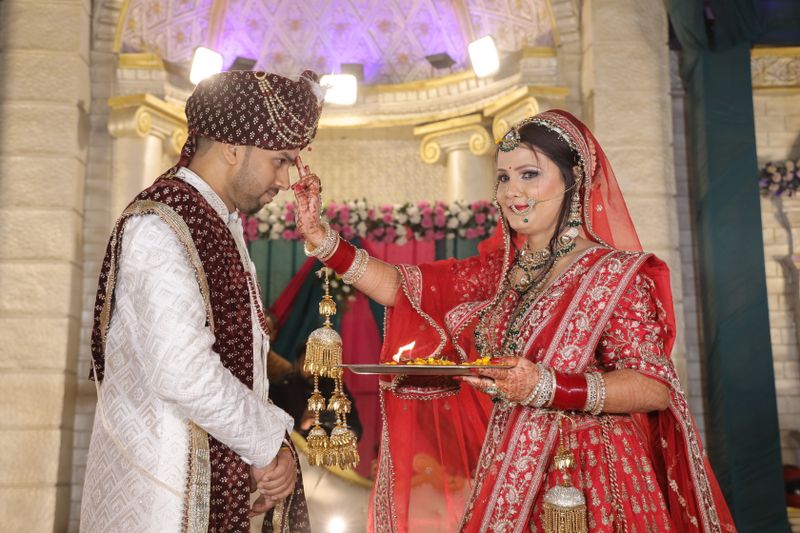
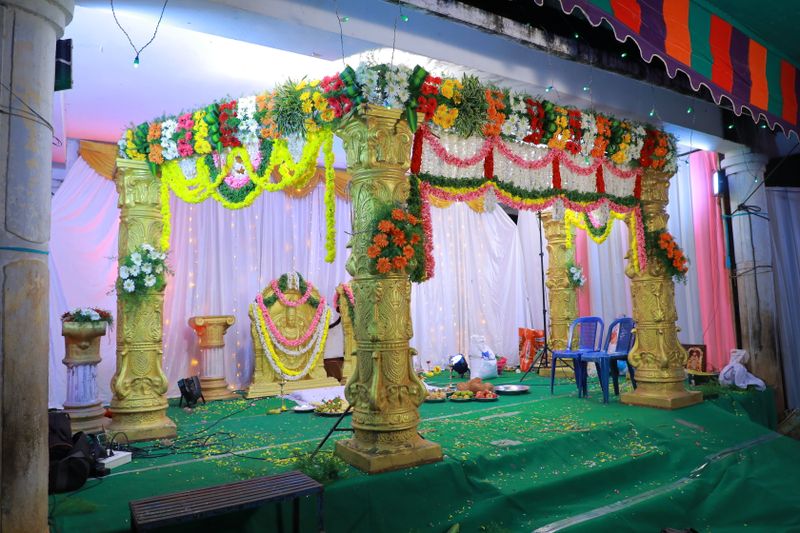
Marriage is a public act in almost every tradition, which is why witnesses appear in forms ranging from named signatories to an entire congregation. Jewish practice requires two valid witnesses to the giving of the ring, and the ketubah is signed and witnessed before the ceremony begins. Many Hindu ceremonies treat the sacred fire as a witness to the vows, with the gathered family present as the human counterpart.
Quaker weddings dispense with an officiant entirely, and everyone present signs the certificate as a witness to what the couple have done. The common thread is that a marriage is not a private arrangement between two people alone.
A physical act that marks the change
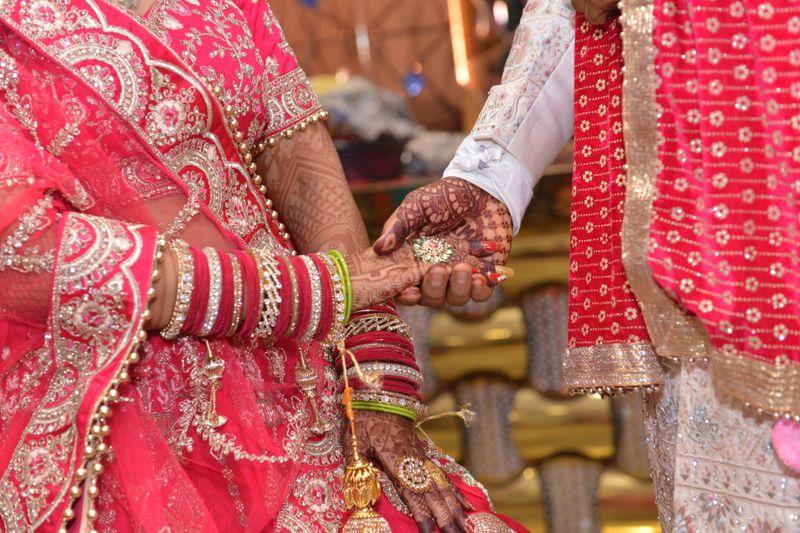
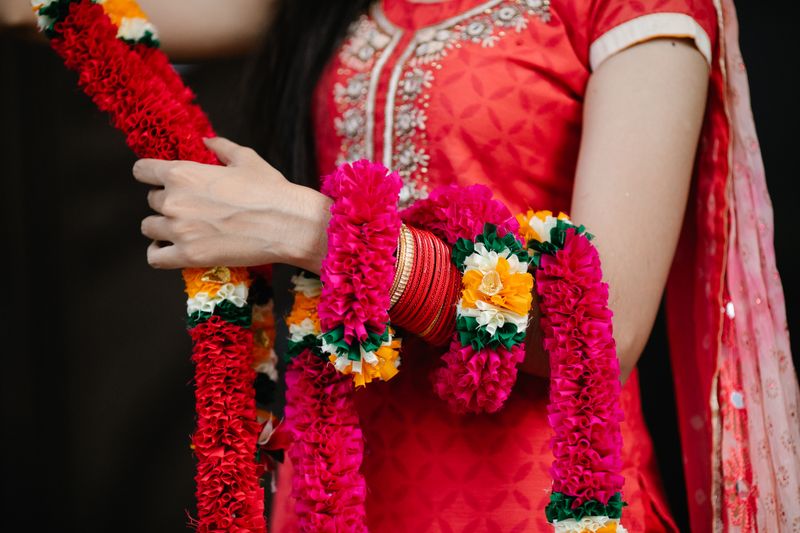
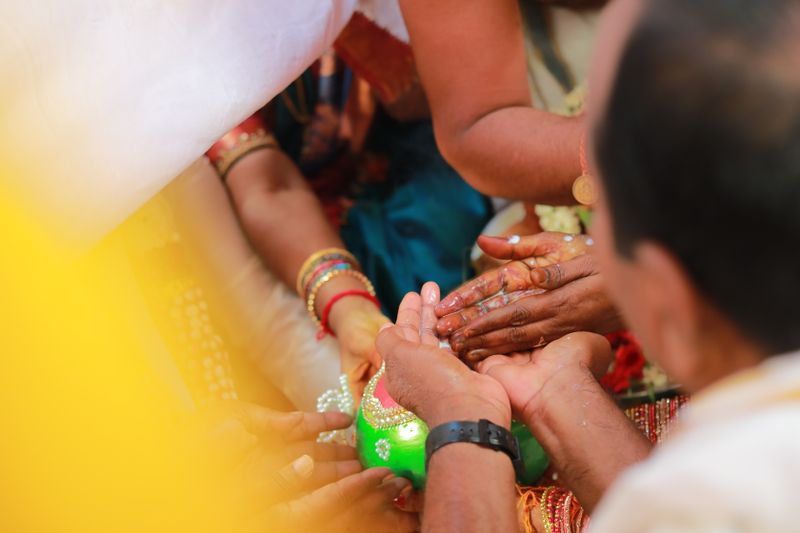
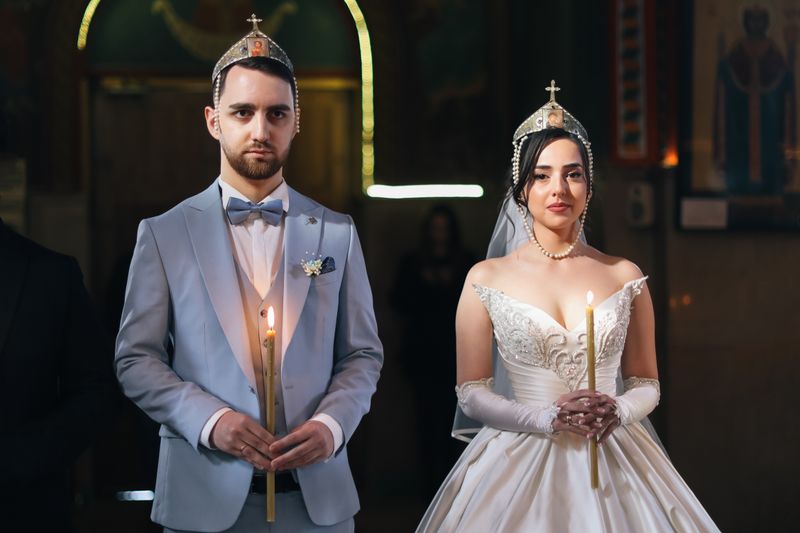
Rings, garlands, cloth, crowns, cords, steps and shared cups all serve the same function of making an invisible change visible. In a Sikh Anand Karaj the couple walk around the Guru Granth Sahib once for each of the four Laavan, and the walking is the ceremony rather than an accompaniment to it. Orthodox Christian ceremonies place crowns on the couple's heads and process three times around a table, with no exchange of vows in the Western sense.
In many Hindu traditions the seven steps of the saptapadi carry a vow each and are treated as the decisive act. The specific object matters far less than the fact that there is a moment everyone present can see.
Words spoken aloud
Declarations, vows, blessings and readings all serve to say publicly what is happening, and most traditions have a fixed core with optional additions around it. The fixed part is often prescribed by religious law or by statute and cannot be altered, which surprises couples planning a personalised ceremony. Where personal vows are permitted, they usually sit alongside the prescribed words rather than replacing them.
Blessings are frequently the largest part by time, and they are addressed to the couple rather than exchanged between them.
Knowing which words are load-bearing and which are decoration tells you exactly where you have freedom.
Who leads it
Some traditions require an ordained or appointed person, some require a state official, and some require neither. In Islam there is no requirement for a mosque or an imam specifically, and any competent person may conduct the nikah provided the conditions are met. In Sikh practice any initiated Sikh may conduct the Anand Karaj, since there is no priesthood in the sacramental sense.
In Buddhist-majority countries marriage is generally a civil and social matter, with monks invited to chant blessings rather than to perform a marriage. Establishing early who must lead your ceremony, and what they require of you, prevents a late and awkward discovery.
Venue contracts are negotiable well before signature and almost never afterwards.
Where the boundaries sit
In some countries a religious ceremony also creates the legal marriage; in others the legal step is separate and must be done before or after. That distinction is one of the few things worth checking formally, because the rules differ by country and frequently by region.
Once the deposit is paid, it is entirely normal for couples to hold a small legal ceremony and a separate religious or cultural one, sometimes days or months apart. Neither is more real than the other, and describing one as the proper wedding causes needless upset within families. Ask your officiant and your local authority what applies to you rather than relying on what happened at somebody else's wedding.
The takeaway
Look for the consent, the witnesses, the visible act and the spoken words, and any ceremony becomes legible.
It is a party with paperwork attached. Keep them in that order.
Questions readers ask
Do all weddings need vows?
No. Orthodox Christian ceremonies contain no vows in the Western sense, and several traditions express the commitment through action or through a contract rather than spoken promises.
Can a ceremony be entirely written by the couple?
It depends on the tradition and the jurisdiction. Religious ceremonies usually have a fixed core, and civil ceremonies typically contain prescribed legal words with limited room around them.
Also by Ruchika Sethi
- What Suppliers Are Really Asking For When They Want Your TimingsPlanning & Timeline
- How Long an Engagement Needs, Counted Backwards From the ConstraintsPlanning & Timeline
- One Person Holding the Plan Beats Four People Holding FragmentsPlanning & Timeline
- The Questions to Ask on a Venue Visit That Nobody Puts on the ListVenues