Ceremonies & Rituals
Christian Wedding Ceremonies Differ Far More Than Most People Expect
A Catholic nuptial mass, an Orthodox crowning and a free church service have little in common beyond the couple. Assuming one form is universal causes real confusion.
The options around differences between Christian wedding rites are set out side by side below, with the conditions that genuinely favour one over the other.
The difference in one place
- In Catholic teaching the couple confer the sacrament on each other.
- Orthodox ceremonies centre on crowning rather than vows.
- Preparation requirements and permitted content vary widely by church.
Catholic ceremonies
The Catholic Church treats marriage as a sacrament, and in its teaching the couple themselves are the ministers of it. The priest or deacon acts as the Church's official witness, and the exchange of consent is the essential element of the rite.
The wedding may take place within a nuptial mass or outside mass, and that choice affects the length and the participation of guests considerably. Preparation programmes are commonly required and take time, so contacting the parish early is a practical necessity rather than a courtesy. Hispanic Catholic practice often includes the arras, thirteen coins, and the lazo, a cord or veil placed around the couple.
Orthodox ceremonies
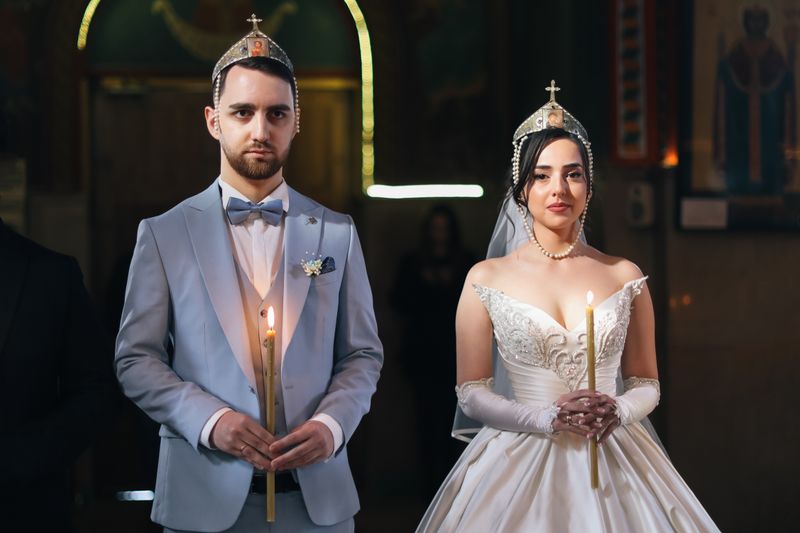
Orthodox Christian weddings consist of two services, the betrothal with the exchange of rings and the crowning that follows it. Crowns, often called stefana and joined by a ribbon, are placed on the couple's heads and are the central image of the rite. There are no vows in the Western sense, since the marriage is understood as performed by God through the Church rather than created by the couple's promises.
The couple share a common cup and process three times around a table in what is commonly called the Dance of Isaiah. Sponsors, often called the koumbaros or koumbara, have a defined liturgical role rather than a decorative one.
Protestant and free church ceremonies
Anglican and Lutheran churches have set liturgies with prescribed elements, while many free churches allow considerable freedom in structure. The recurring shape is a declaration of intent, the vows, the giving of rings, prayers and a pronouncement. Vows may be fixed by the liturgy, chosen from options, or written by the couple depending entirely on the church.
Music, readings and who may participate vary between denominations and often between individual congregations. The minister is the person to ask, since two churches of the same denomination can differ noticeably in practice.
Other Christian traditions
Ethiopian, Coptic, Armenian and Syriac churches each have distinct rites with their own vestments, crowns, blessings and lengths. Quaker weddings have no officiant at all, and the couple marry themselves in the presence of the meeting, speaking their promises in the silence.
Everyone present at a Quaker wedding signs the certificate, making the whole gathering the witness in a literal sense. Some churches recognise marriages conducted elsewhere and others require their own rite for a marriage to be recognised within the community.
If you are marrying across two Christian traditions, both clergy should be part of the conversation from the beginning.
What is usually fixed
Most churches have elements that cannot be altered, typically the consent, the vows and any words prescribed by law or liturgy. Music and readings are frequently governed by the church's own rules, and secular music is not permitted everywhere. Photography and video are often restricted during the ceremony, and the restriction is about reverence rather than about the photographer.
Once the deposit is paid, ask what may be added rather than what may be changed, since additions are more often possible than substitutions. Clergy generally explain this readily and would rather do so early than negotiate it in the final month.
Whether the church ceremony marries you legally
In some countries a church wedding conducted by an authorised minister also registers the marriage legally. In others, including much of continental Europe and Latin America, a civil ceremony is required and the church service follows separately. That is a completely normal arrangement and is not a sign that the religious ceremony is secondary.
On the day itself, establish which applies where you are marrying, and if you are marrying abroad, check how it will be recognised at home. The clergy will know, and the civil authority will confirm, and it is worth asking both.
Side by side
| Consideration | What it means in practice |
|---|---|
| Catholic ceremonies | In Catholic teaching the couple confer the sacrament on each other. |
| Orthodox ceremonies | Orthodox ceremonies centre on crowning rather than vows. |
| Protestant and free church ceremonies | Preparation requirements and permitted content vary widely by church. |
The takeaway
Ask the specific church, not the denomination, because the practical answers vary from parish to parish.
It is a party with paperwork attached. Keep them in that order.
Questions readers ask
Can we write our own vows in a church?
It depends entirely on the denomination and often on the individual minister. Many liturgies fix the vows precisely, while others allow additions around them, so ask early rather than assuming.
Why do some countries require a civil ceremony as well?
Because the state does not delegate the registration of marriage to religious bodies there. The church service remains the religious marriage; the civil act is what the state recognises.
Also by Preeti Ramnani
- Anand Karaj: How a Sikh Wedding Is Actually StructuredCeremonies & Rituals
- The Nikah: Consent, Witnesses and the Mahr ExplainedCeremonies & Rituals
- Rituals That Honour Parents and Elders, and Why They MatterCeremonies & Rituals
- Building a Guest List by Rule Instead of by ArgumentGuests & Etiquette